


Observatories across India that you should visit!

India has a rich culture of astronomy, from ancient astronomers crafting accurate instruments to modern scientists creating marvels at unprecedented altitudes. This torch of astronomical research and stargazing is passed down and carried by numerous astronomers throughout different levels for centuries.
For amateur astronomers, simple refractor telescopes with aperture sizes ranging from 6 to 10 inches are commonly used, raising the bar with our 16-inch telescope, enhancing to a more immersive experience. However, once you move beyond the realm of amateur observation into the professional one, the complexity of instruments and the scale of aperture sizes grow exponentially. Professional observatories utilise massive, highly sophisticated and specialised telescopes designed to capture the faintest whispers of light from galaxies millions of light-years away, revealing a universe that remains hidden to the naked eye.
Today, we are going to explore these observatories harbouring wonders, spread across India and look into research that takes place there.
1. The Giant Metrewave Radio Telescope (GMRT), NCRA-TIFR, Pune
Located 10 Km near Narayangaon, Pune, this marvellous creation gazes at the universe in frequencies that we can’t see with our eyes, the Radio frequencies. An array of 30 radio dishes spread across 25 kilometres has the ability to image & study radio emissions from structures of even faraway galaxies. GMRT has been instrumental in detecting new pulsars, studying galaxy evolution, and probing the early universe through 21 cm hydrogen line observations and also studying radio emission from the Sun and Solar flares.

Beyond its cutting-edge research, the GMRT also engages with the public, offering opportunities for supervised visits on designated days with prior registration, allowing people to witness this impressive feat of engineering and learn about the wonders of radio astronomy.
2. The Indian Astronomical Observatory (IAO), situated in Hanle, Ladakh
One of the highest observatories in the world, at an altitude of 4500 meters in Hanle, Ladakh, gives top-of-the-world views for astrophysical studies. Even in cold temperatures, it offers pristine atmospheric conditions for astronomical observations due to its remote location, clear skies, and minimal light pollution

Its well-known telescopes are
Himalayan Chandra telescope, a 2-meter aperture telescope which studies Visible light and infrared astronomy,
Major Atmospheric Cherenkov Experiment (MACE) Telescope: it is an imaging atmospheric Cherenkov telescope, which also studies High Energy Astrophysics by detection of very-high-energy (VHE) gamma rays.

This picturesque observatory, standing tall in Ladakh, is open with advanced booking for visitors. The visit typically includes a tour of the facility and a presentation about the telescopes, such as the 2-meter Himalayan Chandra Telescope, and the research conducted. Star parties are often held near an observatory, offering a visit inside, too.
3. Aryabhatta Research Institute of Observational Sciences (ARIES), Nainital
Near the scenic lake of Nainital, in the foothills of the Himalayas, are situated the ARIES observatories. ARIES conducts research in astronomy, astrophysics, and atmospheric sciences. It focuses on stellar astrophysics, solar physics, exoplanets, and atmospheric studies. ARIES has multiple telescope facilities among which the world-famous famous are,

3.6 – meter Devasthal Optical Telescope (DOT) - Largest optical telescope in India.
International Liquid Mirror Telescope (ILMT) - The World’s only Liquid mirror telescope, using a spinning parabolic dish filled with Mercury to deal with Atmospheric turbulence.
Day visits may include viewing the sun and a visit to a poster gallery. Evening visits offer the opportunity for stargazing using telescopes. Prior permission is mandatory for both types of visits and can be requested through an online application form on the ARIES website. The Devasthal facility, where larger telescopes are located, generally has more restricted access, often limited to Saturdays for a short period with prior permission.
4. Kodaikanal Solar Observatory, Kodaikanal, Tamilnadu
Kodaikanal Solar Observatory is located in Kodaikanal, Tamil Nadu, situated on the southern tip of the Palani Hills in Southern India, is a historic astronomical facility that offers public visitation. Operated by the Indian Institute of Astrophysics (IIA), it holds significant historical solar data. KSO primarily focuses on solar physics and solar-terrestrial relationships. It conducts long-term studies of solar activity, including sunspots, solar flares, and the solar chromosphere. The observatory also contributes to studies of the Earth's ionosphere and geomagnetic field.
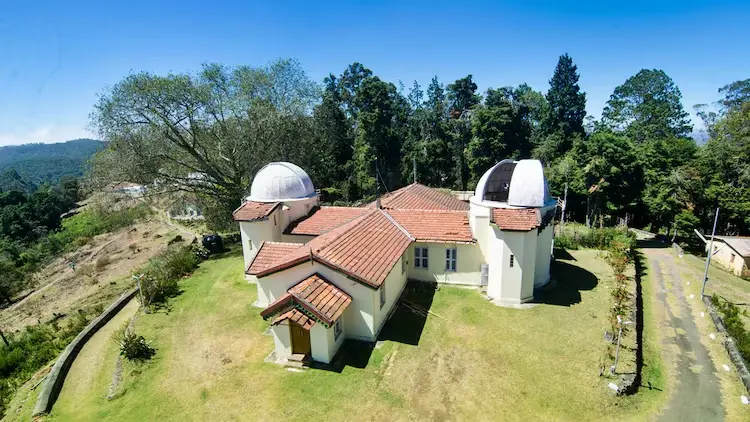
Main telescope facilities include,

H-Alpha telescope – Observing the chromospheric region of the sun in H-Alpha wavelength.
Twin telescope – Two telescopes mounted together, with 1 observing in Ca–K wavelength and the other observing a white light image of the Sun
Solar Tunnel telescope – A two-mirror coelostat on an 11 m tower directs sunlight into a 60 m underground tunnel, where a 38 cm lens telescope produces a 34 cm solar image at the focal plane.
A visit to the Kodaikanal Solar Observatory typically includes access to an astronomy museum featuring pictorials, models, historical instruments, and sometimes a live solar image projection, with guidance provided within designated areas.
Whether you're a curious student, an amateur stargazer, or a seasoned astrophotography enthusiast, these observatories across India offer a gateway to the cosmos.
Ready to take your passion to new heights?
Join us for the upcoming Ladakh Astro-Trip because,
Mauka Bhi Hai, Dastoor Bhi Hai.


Really loved the photography in this blog! If you're inspired to travel, explore our Ladakh tour packages.