


How do Telescopes work?

Ever wondered what the stars look like up close? At Arc Educators, we bring the universe a little closer to you with Mumbai’s largest telescope, right on our stargazing deck. This powerful optical marvel isn’t just a tool, it’s your ticket to the cosmos. You can see the craters of the Moon in sharp detail, the moons of Jupiter, and even galaxies millions of light-years away. But how did we get here? Let’s go back in time.

Who Invented Telescopes ?
The story of the telescope begins not with NASA or giant observatories, but in a quiet workshop in the Netherlands in 1608. A spectacle maker named Hans Lippershey crafted a simple device to see distant objects more clearly. It didn’t take long before this invention caught the attention of someone you probably know, Galileo Galilei.

Yes, that Galileo. He wasn’t the inventor, as people often believe, but he was the first to point this new device at the heavens. And what he saw changed everything. Craters on the Moon. Moons orbiting Jupiter. A universe far more dynamic than anyone had imagined. He published his observations in Sidereus Nuncius, a rare book that turned the telescope into the most important tool in astronomy.
From Galileo’s humble spyglass to Mumbai’s largest telescope today, and even to the massive James Webb Space Telescope orbiting far beyond Earth, telescopes have taken us on an incredible journey.
How does it work?
Let’s break it down.
A telescope is an optical device designed to gather and magnify light from distant objects. Its core principle is simple but powerful: collect more light than the human eye, so that even the faintest, farthest celestial objects become visible.
Optical Telescopes come in many shapes and sizes, but most of them fall into three main designs. They each have their unique way of bending and reflecting light.
Refracting Telescopes
These lenses bend (or "refract") light, bringing it into focus. The front lens, called the objective, gathers light and focuses it into an image. The eyepiece then magnifies this image for your eye.

Example: simple refractor telescope by Explore Scientific.
Reflecting Telescopes
These use mirrors instead of lenses. A curved primary mirror gathers light and reflects it to a secondary mirror, which then redirects it to your eyepiece or camera.

Example: The Sky watcher 6 inch Newtonian telescope at Arc Educators.
Catadioptric Telescopes (Compound Telescopes)
These are the best of both worlds. They combine lenses and mirrors to give sharper images, correct visual errors (called aberrations), and pack powerful optics into a compact size.
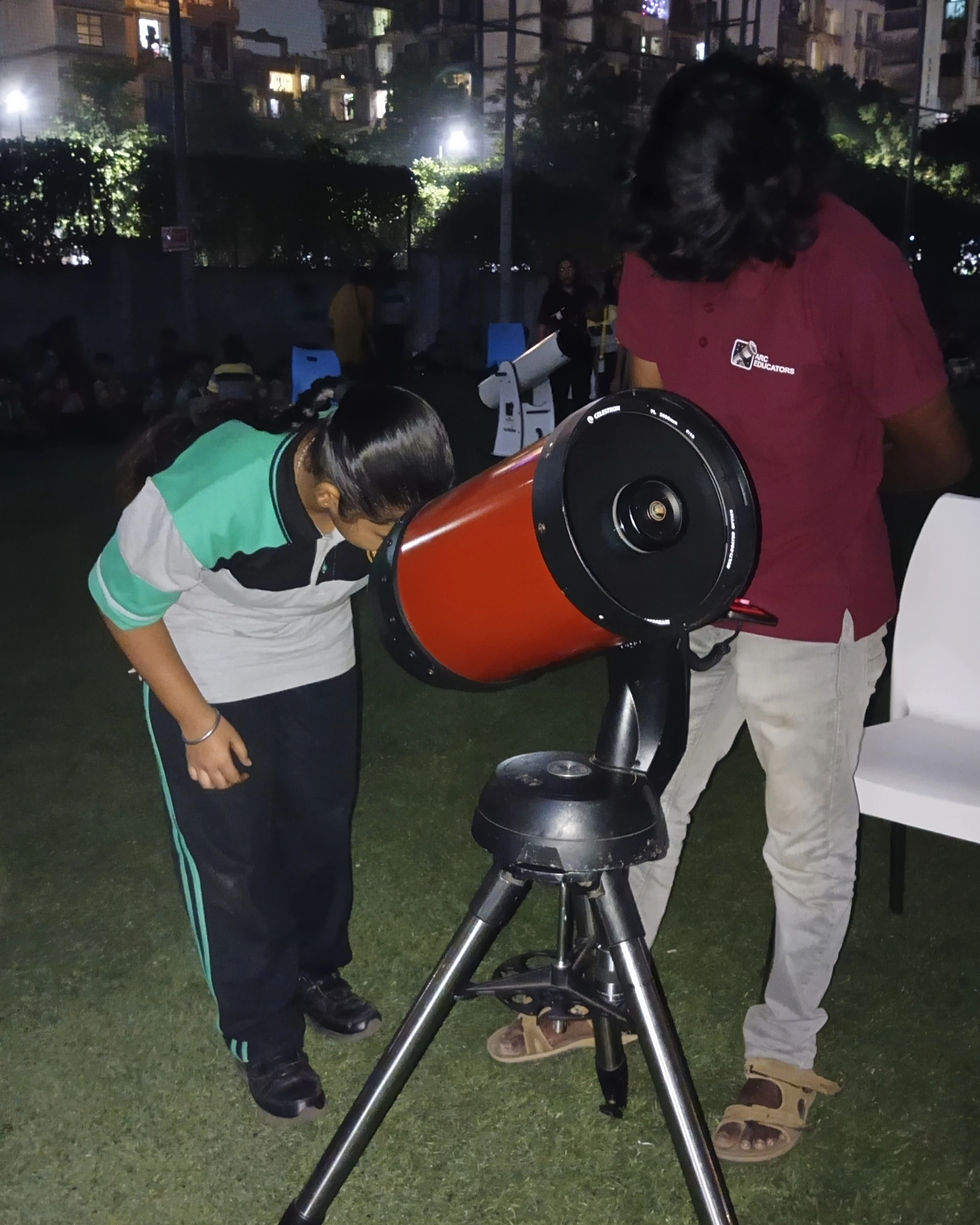
Example: Celestron’s Schmidt-Cassegrain telescopes, like the one we use at Arc Educators.
Want to go beyond what the eye can see? Stay tuned, because next, we’ll explore telescopes that observe not just light, but radio waves, X-rays, gamma rays, and infrared... unlocking secrets of the invisible universe.
But as powerful as optical telescopes are, our eyes only see a tiny part of the universe, just the visible light. What about everything else? The universe also whispers in radio waves, glows in infrared, and explodes in X-rays and gamma rays. To listen to those cosmic signals, we’ve built telescopes that can see in those invisible wavelengths.
Let’s explore these marvels.
Radio Telescopes
Imagine tuning into the universe as if it were a giant radio station. That’s exactly what radio telescopes do. Instead of collecting light, they gather radio waves, long, low-frequency signals sent by some of the most fascinating objects out there, like pulsars, quasars, etc. These telescopes don’t look like your typical scope. They’re often giant dishes spread across valleys or deserts.

Examples:
• uGMRT (Upgraded Giant Metrewave Radio Telescope) right here in India.
Infrared Telescopes
Some parts of the universe are shrouded in dust, cosmic clouds that block visible light. But dust doesn’t stop heat. Infrared telescopes pick up this thermal radiation and let us see what's hidden: newborn stars, forming galaxies, and even exoplanets. These telescopes often must be cooled to near absolute zero and placed in space to avoid Earth’s heat.

Example: The James Webb Space Telescope (JWST), humanity’s most advanced eye in the sky, sees the universe in stunning infrared detail.
X-ray & Gamma-ray Telescopes
Now we’re diving into the high-energy universe. X-ray and gamma-ray telescopes don’t just look at light, they observe the universe’s most violent and extreme events: black hole collisions, exploding stars, and even matter falling into neutron stars. Since X-rays and gamma rays get absorbed by Earth’s atmosphere (thankfully for us), these telescopes must be launched into space.

Example: Chandra X-ray Observatory
So, from simple glass lenses to giant dishes and space-based observatories, telescopes have evolved into time machines. They let us peer into the distant past because light takes time to travel. When we look at a star a billion light-years away, we’re seeing it as it was a billion years ago.
Whether you’re standing under the stars with us at Astrocamp or gazing through data sent from orbiting giants like JWST, every telescope tells a story, from the very beginning of time to the mysteries still waiting to be discovered.


Comments